
PromisePro - Delivery Estimation
PromisePro is a service that answers one question for any item, anywhere: can we get it to this shopper fast — and exactly when will it arrive? Give it an item, a quantity, and a destination ZIP, and it returns the order-by cutoff time and the resulting delivery date from the fastest fulfillment center that can actually ship it.
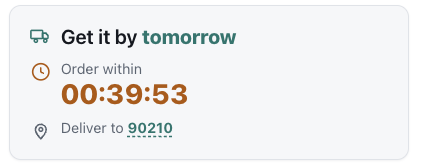
It's built to power delivery promises on storefronts — the "Order within 4h 12m → arrives Tuesday, Jun 24" badge that turns a vague "ships soon" into a concrete, trustworthy commitment at the moment of purchase.
It shows an exact date+countdown for genuinely fast items, a "Get it between X–Y days" window for moderately fast items (under 7 transit days), and nothing otherwise — never a weak or misleading promise beyond that window.
What it does
Behind a single request, PromisePro:
- Finds which fulfillment centers (FCs) currently have the item in stock (at least the requested quantity).
- Looks up shipping routes from those FCs to the shopper's ZIP.
- Picks the fastest viable option, and if today's order cutoff has already passed, rolls forward to the next day that can still deliver — so the cutoff it returns is always in the future.
The request and response, at a glance:
GET /v1/delivery-estimate?item_id=ABC123&qty=1&destination_zip=75087{
"cutoff_time": "2026-06-24T00:00:00Z",
"estimated_delivery_date": "2026-06-26",
"transit_days": 2
}If the item can't be promised — out of stock, no route to that ZIP, or unknown item — it returns a clear status instead of a guess. It never invents a delivery date.
Bundles: one promise for several items
Selling one listing that ships as several components (a bundle whose parts move as individual items in Spreetail's system)? Send them all in a single request and PromisePro returns one combined promise for shipping them together:
POST /v1/delivery-estimate{
"postalCode": "75087",
"items": [
{ "spin": 427936, "qty": 2 },
{ "spin": 427937 }
]
}The bundle ships on a single shared order date — the earliest day on which every component is orderable — and the response is the same { cutoff_time, estimated_delivery_date, transit_days } shape as the single-item call: the most-binding (earliest) cutoff, the latest component arrival, and the slowest component's transit. It's all-or-nothing — if any one component can't be promised, the whole bundle returns that status rather than a partial promise. (qty is optional and defaults to 1; a single-item bundle is identical to the equivalent single-item request.)
Two ways to use it
1. The drop-in widget (recommended). A small, self-contained script renders the delivery-promise badge on a product page, calls the API for you, and shows the live countdown — only when the delivery is genuinely fast. It's fail-closed: if anything is off, it shows nothing rather than a weak or misleading promise.
- Developer Guide — embed the widget on any storefront (Shopify, BigCommerce, custom, headless): attributes, theming, environments, troubleshooting.
- Shopify Setup (for merchants) — a non-technical, ~15-minute walkthrough to turn the badge on in a Shopify store.
2. The API directly. Call GET /v1/delivery-estimate from your own front end, app, or back-office tooling.
- API Reference — parameters, response shape, and status codes.
Good to know
- It never overpromises. A delivery date is returned only when an FC both stocks the item and has a fast-enough route to the ZIP; otherwise the caller gets a clear "no estimate" status.
- US-only today. Destination is a 5-digit US ZIP.
- Public and rate-limited. The widget endpoint is open (no key) and capped at 100 requests/second, with CORS enabled for in-browser use.
- Always current. Inventory and routes refresh continuously from the systems of record, so estimates reflect what's actually sellable and shippable now.
Where to start
- Selling on Shopify and want the badge live fast → Shopify Setup (for merchants).
- Embedding on another platform or a custom site → Developer Guide.
Updated about 2 months ago